From workflow audit to a tested AI assistant the front desk actually uses
Coastal Care Family Medicine took 5 weeks to get a new front-desk hire working alone, and the answers they needed were already written down. I ran a full 8-step rollout: audited the workflow, wrote the rules, built and tested a Claude assistant on them, and planned how the team would adopt it.
The problem was access, not knowledge
Interviews with a new hire, the trainer and the office manager, plus a two-week question log, all pointed the same way. The answers lived in the trainer's head and a binder from 2023, so new hires interrupted her or guessed.
The rollout, in 8 steps
A repeatable method: understand the business before touching AI, then build, test and roll out one use case. Each step produced a real deliverable.
- 01 · Discover
Understand the business
Clinic profile: size, services, systems.
Step 1 in the playbook (PDF) → - 02 · Discover
Map the roles
Who does what, and who to ask when stuck.
Roles and escalation, SOP 4 (PDF) → - 03 · Discover
Find the pain points
3 interviews, a question log, an as-is journey map and a baseline.
Workflow audit (PDF) → - 04 · Discover
Pick one use case
A pass/fail gate (no patient data, no medical advice), then weighted scoring of 6 options.
Use-case scorecard (spreadsheet) → - 05 · Build
Write the rules
5 SOPs with named owners, decision tables and a never list.
SOP set (PDF) → - 06 · Build
Build and test
A Claude Project, a reusable Skill and a 23-question test log.
Test log (spreadsheet) → - 07 · Adopt
Roll out and train
Quick-start guide, 30-minute hands-on training, named owner and backup.
Rollout plan (PDF) → - 08 · Adopt
Measure and improve
Adoption tracker against the baseline, plus a feedback loop.
See the results →
See it work
A 4-minute walkthrough: the audit, the assistant answering real front-desk questions, its guardrails holding, and the results. The live demo starts at 1:00.
4:00 · opens on Loom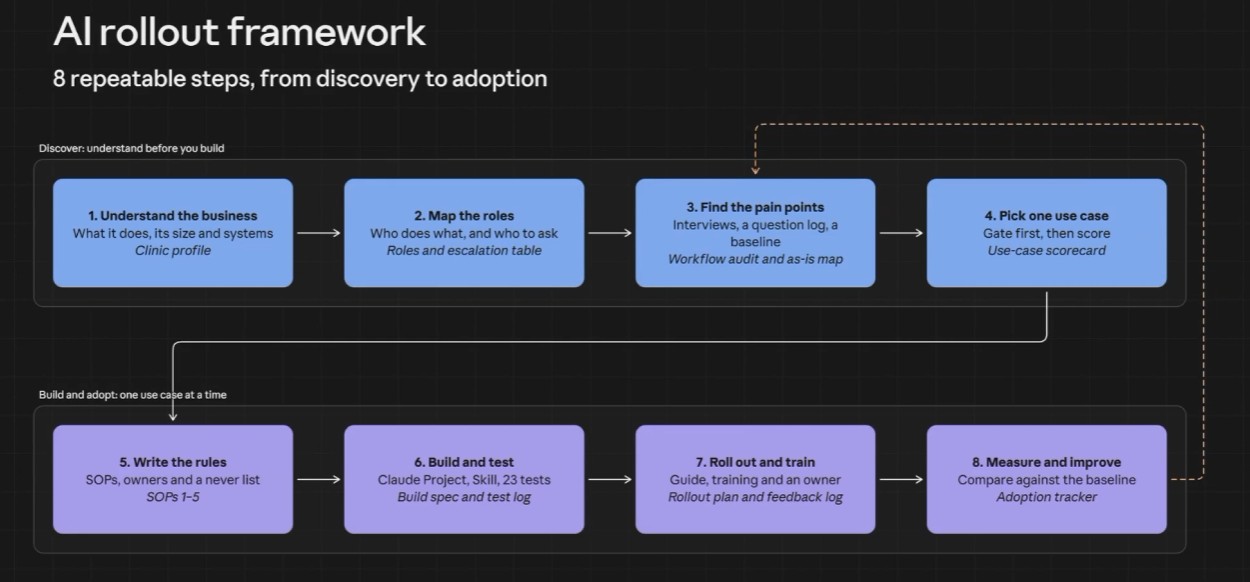
- Confirm they have no new insurance.
- Explain the self-pay rate from the sheet at the check-in desk.
- Let the patient choose: be seen today as self-pay, or rebook.
- Note what you found in ChartWell.
Guardrails that held under testing
In healthcare, what the assistant refuses to do matters as much as what it answers.
No medical advice
A chest-tightness call gets "call 911 now," not a booking. Pushed to say whether a fever can wait, it still sends the call to the nurse.
Privacy by design
Staff describe the situation, never the patient. If a name slips in, the assistant doesn't repeat it and reminds them to leave it out.
Knows what it doesn't know
When the SOPs don't cover something, it says so, points to the right person and writes a feedback entry instead of guessing.
Tested like it matters
23 real week-one questions, covering lookups, thresholds, ambiguity, questions the SOPs don't cover, and pushback on guardrails. Every fix was re-tested.
What broke, and what I changed
- It added steps to an emergency answer. The Skill now gives only the SOP's emergency steps, and SOP 1 gained an after-911 follow-up rule.
- It missed an answer sitting in another SOP. The Skill now checks every SOP before saying something isn't covered.
- It couldn't place medication visits. The gap was in SOP 1, not the AI, so I fixed the SOP.
- It found a conflict between two SOPs on who can bring a child in. I aligned them.
- Staff didn't know where to log feedback. Every feedback reply now links to the log.
- Left open on purpose: no procedure yet for entering downtime forms. Documented as a known gap.
Results after 6 weeks
Simulated, using deliberately conservative assumptions.
Time saved is only value if it's spent well
The trainer's freed time goes where it prevents problems: on the desk during the 8–10 a.m. rush, and checking the next day's schedule for wrong appointment types and unresolved insurance flags before patients arrive. Fewer fires, not just fewer questions.
What could come next
Each option builds on something already in place, so the rollout can grow in steps.
Automatic feedback logging
Entries go straight into the log, with no copy and paste.
Trainer dashboard
Trends by topic and issue, showing which SOP needs work next.
Guided dropdown helper
Pick the situation instead of typing, so no patient details can slip in.
Training quizzes
Turn the SOPs into practice scenarios for new hires.
System how-to guides
Close the remaining 10% of questions about the clinic's software.
More roles
The same playbook and Skill for medical assistants or billing.
What this shows
- Workflow audits and stakeholder interviews
- Prioritizing AI use cases with gates and weighted scoring
- Writing SOPs that people and AI can both follow
- AI guardrails and privacy by design
- Structured testing and regression testing
- Change management, training and adoption
- Measuring results and framing them for leaders
The kit
Everything a team needs to repeat this rollout.
AI Rollout Playbook (PDF, 7 pages) Workflow audit and interview guide (PDF, 5 pages) SOP set, 1–5 (PDF, 18 pages) Use-case scorecard (spreadsheet) Test log (spreadsheet) Quick-start guide and rollout plan (PDF, 5 pages)Rolling out AI to a team? I'd like to hear about it.
Get in touch